The End of the Road
25 May 2016 10:08 #68544
by AndrewP
The End of the Road was created by AndrewP
This is my second run with Kyle. (He is currently working in a remote village about 30km south of Afriski) Once again I did the long drive to Afriski, but this time I carried on beyond. About 10km I later, reached a junction and sure enough, he had arrived. Good thing too because it was already getting dark and it would have been fun to try find him without the aid of a cell phone. Turns out he spent his time waiting for me to arrive on a nearby summit watching not only the sunset but also the moonrise.
We drove through Mokotlong and after a few incorrect turns made it onto an unsignposted road heading in the right direction. To no where. Realising that we would draw a crowd if we cooked at a village we stopped on the side of the road for a tasty treat. After about 2 hours of driving we reached a steep descent that looked bad to go down and impossible to come back up in a normal car. So, we camped right there.
Next morning we got up early and drove about 1km back to the nearest village where we found a clinic. We parked the car here and set off. We saw a lovely sunrise over the Mokotlong valley.
We started off on another split in the road that the map suggested would die soon. 14km later of perfectly driveable road later the road finally disintegrated in the middle of a village.
Nearby construction equipment suggest the road may be continued further in the near future. The road of course winds about rather a lot, trying to follow contours instead of a more direct line that a path would take. This resulted in us putting on a lot more extra distance than originally expected.
We passed through numerous fields, mostly being harvested.
The villages out here we a real treat. No cries for sweets, no barking dogs, and rather the sounds of children playing. There are even a few trees.
We found the Mokotlong highway easily enough and made excellent progress up the valley.
Apparently this is really needed. Must be a sign indicating that aliens should land here.
At this stage, the familiar cliffs of Thaba Putsoa loomed above and I realised we had just found the nearest road access to Thabana Ntlenyana.
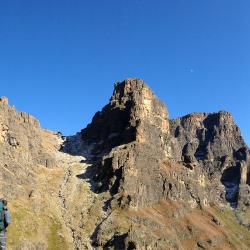
After a while we crossed the Tsolo river and entered the realm of a speed GT. We continued upwards, at a good pace. Along the way, I sneaked in some reccie's for better route options, and after a while we were on the summit of Giants Castle. This is the first time I have ever had time to enjoy the summit so I did just that. Kyle also enjoyed it. He is of course used to the valleys of Lesotho but not to the dramatic cliffs of the Drakensberg. I sneaked in the summit of Giants Pass Peak. I had hoped to get Tent and Hawk as well, but there is only so much daylight around.
Kyle enjoying the view
We had 42.6km on the clock and were clearly set up for a long evening ahead. We decided it would be best to return the same way instead of trying out the ridge behind Giants that heads over Thaba Chitja.With the benefit of hindsight, we took a few shortcuts on the way out. Even so, I got confused at one point in the dark and managed to cross the Mokotlong river without realising it. To do this with a GPS in your hand takes some skill.
In one of the villages we were invited into a toasty warm hut for a chat. Kyle obliged and I made do with polite nods and handshakes. Even eithout understanding a word, it was obvious to me that they were offering food and a warm bed for the night.
Soon we got back onto the road, where we could use the full moon to our advantage. We turned off our headlamps for the final 9km. It was only later that we found out the error of our ways. On the way out, Kyle only turned on the SPOT tracker about 30 minutes after leaving the car. Now, on the way home, at a slower pace, we were observed to move beyond the starting point. So, here I was thinking I was doing the right thing and it turns out I was in the dog box for causing a panic back home.
We made it back to the car shortly begore 11pm. Kyle pulled out more magic and the next thing I knew the guard was waking up his supervisor to arrange a bed for us at the clinic. We were given a bed in the post natal room , but beggars cannot be chosers especially if there is also a gas heater on the go.
Somehow we pulled of 85km, but as almost all of that was on good roads or paths on ground that is not very steep, it is not as impressive as it sounds. I managed the entire haul on a mere 116g of biltong. No sports drinks, no energy bars, just the biltong and ordinary river water. Clearly my body is now fat adapted – now to see what it can do for a speed GT, can I get that pack down to less than 2kg?
My final act as we drove through Mokotlong was to buy a prepaid sim card. It is an admission of defeat, I see a lot of time in the hills of Lesotho lined up
We drove through Mokotlong and after a few incorrect turns made it onto an unsignposted road heading in the right direction. To no where. Realising that we would draw a crowd if we cooked at a village we stopped on the side of the road for a tasty treat. After about 2 hours of driving we reached a steep descent that looked bad to go down and impossible to come back up in a normal car. So, we camped right there.
Next morning we got up early and drove about 1km back to the nearest village where we found a clinic. We parked the car here and set off. We saw a lovely sunrise over the Mokotlong valley.
We started off on another split in the road that the map suggested would die soon. 14km later of perfectly driveable road later the road finally disintegrated in the middle of a village.
Nearby construction equipment suggest the road may be continued further in the near future. The road of course winds about rather a lot, trying to follow contours instead of a more direct line that a path would take. This resulted in us putting on a lot more extra distance than originally expected.
We passed through numerous fields, mostly being harvested.
The villages out here we a real treat. No cries for sweets, no barking dogs, and rather the sounds of children playing. There are even a few trees.
We found the Mokotlong highway easily enough and made excellent progress up the valley.
Apparently this is really needed. Must be a sign indicating that aliens should land here.
At this stage, the familiar cliffs of Thaba Putsoa loomed above and I realised we had just found the nearest road access to Thabana Ntlenyana.
After a while we crossed the Tsolo river and entered the realm of a speed GT. We continued upwards, at a good pace. Along the way, I sneaked in some reccie's for better route options, and after a while we were on the summit of Giants Castle. This is the first time I have ever had time to enjoy the summit so I did just that. Kyle also enjoyed it. He is of course used to the valleys of Lesotho but not to the dramatic cliffs of the Drakensberg. I sneaked in the summit of Giants Pass Peak. I had hoped to get Tent and Hawk as well, but there is only so much daylight around.
Kyle enjoying the view
We had 42.6km on the clock and were clearly set up for a long evening ahead. We decided it would be best to return the same way instead of trying out the ridge behind Giants that heads over Thaba Chitja.With the benefit of hindsight, we took a few shortcuts on the way out. Even so, I got confused at one point in the dark and managed to cross the Mokotlong river without realising it. To do this with a GPS in your hand takes some skill.
In one of the villages we were invited into a toasty warm hut for a chat. Kyle obliged and I made do with polite nods and handshakes. Even eithout understanding a word, it was obvious to me that they were offering food and a warm bed for the night.
Soon we got back onto the road, where we could use the full moon to our advantage. We turned off our headlamps for the final 9km. It was only later that we found out the error of our ways. On the way out, Kyle only turned on the SPOT tracker about 30 minutes after leaving the car. Now, on the way home, at a slower pace, we were observed to move beyond the starting point. So, here I was thinking I was doing the right thing and it turns out I was in the dog box for causing a panic back home.
We made it back to the car shortly begore 11pm. Kyle pulled out more magic and the next thing I knew the guard was waking up his supervisor to arrange a bed for us at the clinic. We were given a bed in the post natal room , but beggars cannot be chosers especially if there is also a gas heater on the go.
Somehow we pulled of 85km, but as almost all of that was on good roads or paths on ground that is not very steep, it is not as impressive as it sounds. I managed the entire haul on a mere 116g of biltong. No sports drinks, no energy bars, just the biltong and ordinary river water. Clearly my body is now fat adapted – now to see what it can do for a speed GT, can I get that pack down to less than 2kg?
My final act as we drove through Mokotlong was to buy a prepaid sim card. It is an admission of defeat, I see a lot of time in the hills of Lesotho lined up
Please login or register to view the images attached to this post.
The following user(s) said Thank You: elinda, Stijn, JonWells, Trev, ghaznavid, tonymarshall, Sabine, Viking, kbresler, Macc, Redshift3, TheRealDave, myriam
Please Log in or Create an account to join the conversation.


25 May 2016 10:57 #68547
by Macc
"The three rules of mountaineering: It’s always further, taller and harder than it looks."
Replied by Macc on topic The End of the Road
Andrew, would you ever be intested in writing an article (or book  ) on what your training consists of to get to a point where you can perform at this level?
) on what your training consists of to get to a point where you can perform at this level? "The three rules of mountaineering: It’s always further, taller and harder than it looks."
Please Log in or Create an account to join the conversation.


25 May 2016 12:21 #68549
by ghaznavid
Replied by ghaznavid on topic The End of the Road
Interesting stuff! Would have been fun to have met up with you guys on Giants Pass Peak, maybe next time plans will work out (and we will actually get as far as we hope to).
Interesting to see your high fat diet working this well. Diet was also a discussion on our trip - I am convinced that the sneaking of more and more junk food into our diets is the cause of myself and Hobbit not getting very far this weekend. We are considering taking a hybrid approach were we incorporate more biltong into our hiking diets and limit sugary treats to half a bar of chocolate per day.
Interesting to see your high fat diet working this well. Diet was also a discussion on our trip - I am convinced that the sneaking of more and more junk food into our diets is the cause of myself and Hobbit not getting very far this weekend. We are considering taking a hybrid approach were we incorporate more biltong into our hiking diets and limit sugary treats to half a bar of chocolate per day.
Please Log in or Create an account to join the conversation.

26 May 2016 10:38 #68557
by AndrewP
Replied by AndrewP on topic The End of the Road
@ Ghaz
At this stage, my dietary explorations have only taken me into the realm of day “hikes”. The real test will be when I start multi-day missions. Please be patient, I will post something when I have a bit more juice to it.
@ Macc
I have by now done so many long hauls like this that I consider it a perfectly normal thing to do. Some people go to the theatre on a Saturday night - I go for a long run. I actually struggle to see why more people do not do the same
My answer to this one though is actually the same as my advice for the Mnweni Marathon. Train for time on your feet and get used to big hills. 80km though is a much bigger ask, so I will expand on those ideas a bit, and there are also 2 extra points to consider.
Time on your feet:
You will be out there for 15 – 20 hours (or maybe even more). That is a lot of time to keep moving. Once again, the best practise for this is long day hikes, and it will help if you can slowly increase your daily mileage. Get in 40km, then 50km, then 60km, preferably in the right terrain. In the same way that Comrades runners value their long runs, you will also need to build in a solid base of hikes of 40km +.
One point that is also relevant for the Mnweni Marathon, but which now become far more critical is stoppage time. This has to be cut down to an absolute minimum. Why?
1. 20 hours goes into the night. You will always go faster in the day than at night, so every minute you stop in the day will add 2 minutes to your overall time
2. You are also going to be out there for a longer day than you are usually awake. Once again, less stoppage in the day means less sleep deprivation and all that goes with it
3. Once you get really tired, stopping for 1 minute is impossible, it will always be 10 min or more. Enough said.
So, how do you reduce stoppage time?
By stop, I mean not moving forward. So, stop includes sit down rests, looking at the view (unless you are walking at the same time), a stand up breather as you plod up the big hill, looking at your GPS or compass/map etc etc.
Pack food and water in such a way that you can get at several hours worth of them without having to take your pack off. Pouches on your waist belt for example do the trick nicely.
I carry up to 4 layers of clothing with me, but will run for 12 hours at a time on the same set of layers. Then, I stop and put everything on/off in a single go. You have to tolerate being a bit hot or cold at almost every point in time, but it hurts your time really badly if you are continuously stopping to change layers.
When you do stop, for the 5 minutes leading up to it, work out exactly what you want to do. Where are all those things in the pack, and what is the optimal sequence to do things in? In 7 minutes, I can stop for a swim, put on or take off all layers of clothing I have, put some tape on my feet for blister care, mix and drink 500ml of Game, take the wrappers from used bars out of the waist belt pouches and fill those pouches with another 7 hours worth of bars. I can also sneak in a look at the satellite tracker to make sure it is on, pack away a headlamp, put on sunscreen and lip ice, look at the view, and even sit down for a 1 minute rest. That can only be done in 7 minutes if you really know what you want to do!
The hills:
80 km in the Drakensberg will typically give you 3500m altitude gain and 3500m loss. That is 2 berg passes as measured car to summit, to car, to summit and back to car, or if measured on the summit, gives you about 10 Durnford ridges in a day. Ouch.
There are now 2 extra points to consider.
Running:
If you want to cover 80km in a day, then you probably have to be fit enough for a 7h30 Mnweni Marathon. You simply have to be able to run 20km on a road, and once in the hills will be aiming to run all downhills, flats while still fresh, and then power hike the rest.
Darkness:
You are now forced to travel at night. Get a proper headlamp. Accept that you speed drops at night as does the temperature, so you need a lot more clothing to keep you warm than during the day. It is also very cold to stop moving, so your ability to keep moving now becomes far more important.
You also need to know how to navigate in the dark. So, learn how to use your GPS. By this I mean that you must be able to use it better than the guys at Navworld. Know the difference between routes and tracks and which to use when. Know how to use the “compass” screen for a big arrow instead of the silly “triangular dot” on the map screen (bigger object to view means you can look at GPS while moving). Also, make sure you have a contour map loaded onto the GPS itself so that you can plan a new route on the fly if you go slightly off track. PS, it is almost impossible to navigate in the dark up a steep hill, following a GPS track if you try to zig zag up the hill. You want to be able to walk in as straight a line as possible
At this stage, my dietary explorations have only taken me into the realm of day “hikes”. The real test will be when I start multi-day missions. Please be patient, I will post something when I have a bit more juice to it.
@ Macc
I have by now done so many long hauls like this that I consider it a perfectly normal thing to do. Some people go to the theatre on a Saturday night - I go for a long run. I actually struggle to see why more people do not do the same
My answer to this one though is actually the same as my advice for the Mnweni Marathon. Train for time on your feet and get used to big hills. 80km though is a much bigger ask, so I will expand on those ideas a bit, and there are also 2 extra points to consider.
Time on your feet:
You will be out there for 15 – 20 hours (or maybe even more). That is a lot of time to keep moving. Once again, the best practise for this is long day hikes, and it will help if you can slowly increase your daily mileage. Get in 40km, then 50km, then 60km, preferably in the right terrain. In the same way that Comrades runners value their long runs, you will also need to build in a solid base of hikes of 40km +.
One point that is also relevant for the Mnweni Marathon, but which now become far more critical is stoppage time. This has to be cut down to an absolute minimum. Why?
1. 20 hours goes into the night. You will always go faster in the day than at night, so every minute you stop in the day will add 2 minutes to your overall time
2. You are also going to be out there for a longer day than you are usually awake. Once again, less stoppage in the day means less sleep deprivation and all that goes with it
3. Once you get really tired, stopping for 1 minute is impossible, it will always be 10 min or more. Enough said.
So, how do you reduce stoppage time?
By stop, I mean not moving forward. So, stop includes sit down rests, looking at the view (unless you are walking at the same time), a stand up breather as you plod up the big hill, looking at your GPS or compass/map etc etc.
Pack food and water in such a way that you can get at several hours worth of them without having to take your pack off. Pouches on your waist belt for example do the trick nicely.
I carry up to 4 layers of clothing with me, but will run for 12 hours at a time on the same set of layers. Then, I stop and put everything on/off in a single go. You have to tolerate being a bit hot or cold at almost every point in time, but it hurts your time really badly if you are continuously stopping to change layers.
When you do stop, for the 5 minutes leading up to it, work out exactly what you want to do. Where are all those things in the pack, and what is the optimal sequence to do things in? In 7 minutes, I can stop for a swim, put on or take off all layers of clothing I have, put some tape on my feet for blister care, mix and drink 500ml of Game, take the wrappers from used bars out of the waist belt pouches and fill those pouches with another 7 hours worth of bars. I can also sneak in a look at the satellite tracker to make sure it is on, pack away a headlamp, put on sunscreen and lip ice, look at the view, and even sit down for a 1 minute rest. That can only be done in 7 minutes if you really know what you want to do!
The hills:
80 km in the Drakensberg will typically give you 3500m altitude gain and 3500m loss. That is 2 berg passes as measured car to summit, to car, to summit and back to car, or if measured on the summit, gives you about 10 Durnford ridges in a day. Ouch.
There are now 2 extra points to consider.
Running:
If you want to cover 80km in a day, then you probably have to be fit enough for a 7h30 Mnweni Marathon. You simply have to be able to run 20km on a road, and once in the hills will be aiming to run all downhills, flats while still fresh, and then power hike the rest.
Darkness:
You are now forced to travel at night. Get a proper headlamp. Accept that you speed drops at night as does the temperature, so you need a lot more clothing to keep you warm than during the day. It is also very cold to stop moving, so your ability to keep moving now becomes far more important.
You also need to know how to navigate in the dark. So, learn how to use your GPS. By this I mean that you must be able to use it better than the guys at Navworld. Know the difference between routes and tracks and which to use when. Know how to use the “compass” screen for a big arrow instead of the silly “triangular dot” on the map screen (bigger object to view means you can look at GPS while moving). Also, make sure you have a contour map loaded onto the GPS itself so that you can plan a new route on the fly if you go slightly off track. PS, it is almost impossible to navigate in the dark up a steep hill, following a GPS track if you try to zig zag up the hill. You want to be able to walk in as straight a line as possible
The following user(s) said Thank You: jeremyeb, ghaznavid, Sabine, kbresler, AdrianT, Macc, KevinR, Coeta
Please Log in or Create an account to join the conversation.
26 May 2016 14:33 - 26 May 2016 14:35 #68560
by Macc
"The three rules of mountaineering: It’s always further, taller and harder than it looks."
Replied by Macc on topic The End of the Road
Thank you very much Andrew, I appreciate your insight
"The three rules of mountaineering: It’s always further, taller and harder than it looks."
Last edit: 26 May 2016 14:35 by Macc.
Please Log in or Create an account to join the conversation.
27 May 2016 16:44 #68572
by tiska
The thing is that amongst many other issues, it takes a very special anatomy to be able to maintain those distances so that they can begin to seem normal. In particular, the balance between muscle and tendon needs to be in equilibrium. Most people will have an imbalance here that will appear when extreme training is sustained. For me muscles developed more than tendons at a time when running 42 km felt like a very normal and easy thing to do once a week on a Saturday morning. Once that imbalance is set up, something breaks: muscles if the tendons are stronger, tendons if the muscles are stronger. The balance between the two bits of anatomy is then hard to re-establish. Amongst many other things, including the imagination to see the impossible, AP seems blessed with unusually good anatomical cooperation.
Replied by tiska on topic The End of the Road
As ever, AP modestly makes the impossible at the extreme end of the spectrum seem like quite the norm.AndrewP wrote: @ Ghaz
I have by now done so many long hauls like this that I consider it a perfectly normal thing to do. Some people go to the theatre on a Saturday night - I go for a long run. I actually struggle to see why more people do not do the same
The thing is that amongst many other issues, it takes a very special anatomy to be able to maintain those distances so that they can begin to seem normal. In particular, the balance between muscle and tendon needs to be in equilibrium. Most people will have an imbalance here that will appear when extreme training is sustained. For me muscles developed more than tendons at a time when running 42 km felt like a very normal and easy thing to do once a week on a Saturday morning. Once that imbalance is set up, something breaks: muscles if the tendons are stronger, tendons if the muscles are stronger. The balance between the two bits of anatomy is then hard to re-establish. Amongst many other things, including the imagination to see the impossible, AP seems blessed with unusually good anatomical cooperation.
The following user(s) said Thank You: AndrewP
Please Log in or Create an account to join the conversation.