
Project Namahadi was a team building excercise conducted in an area of the Drakensberg that sees relatively few hikers. The following is a journal of that trip, which provides some useful insights and information for others that may want go there too.
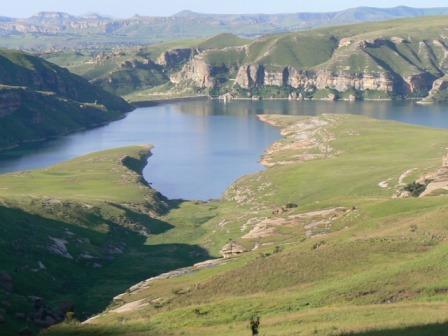
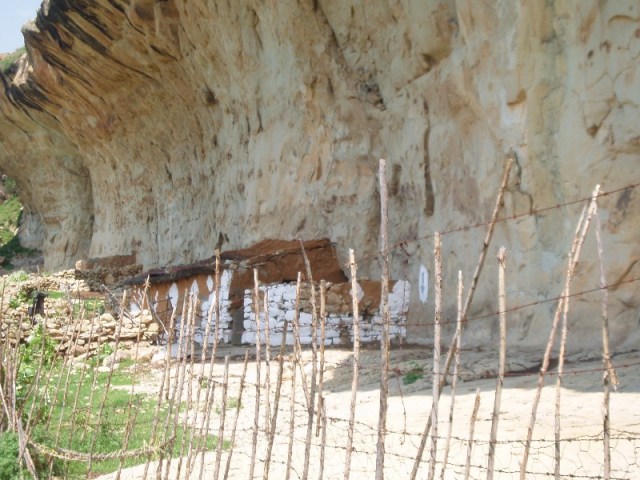
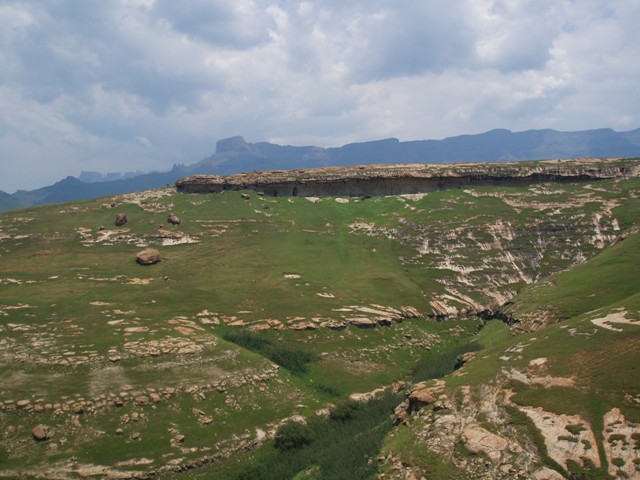
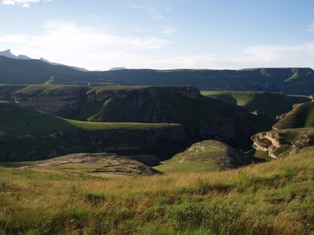
The Namahadi River is on the border of Lesotho and the Orange Freestate in South Africa. Project Namahadi started at Fika Patso (GPS: S28 40’0.89” E28 50’54.67”) (left), which is at the top of the Fika Patso Dam (below). This was constructed by Italian prisoners and the location of Fika Patso is where the engineers who designed the dam lived. It is important to note that this location, although at the top of the hill next to a breathtaking view, faces the opposite. Fika Patso should be used as a base for leaving your car or at the end of a long road journey. If possible, we recommend that you rather arrive at Fika Patso in the morning and start your journey so that you can spend as much day time and camp on the breathtaking Drakensberg mountain range instead. When you continue on your journey, your first point of interest will be the ledge show in the picture below.
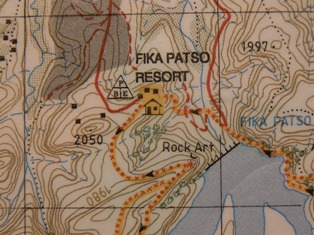
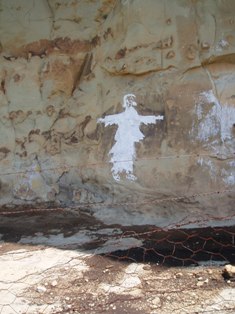
It is about a 20 minute walk to where you will be enthralled with rock art and bushman paintings. You may have to do some exploration along the cave walls in order to find the faint remains of the bushman art. Several people have added their own art to the walls which is sad because these beautiful pieces of art and history must be preserved. Along these walls you will also find some fences where some of the local Sotho people are still living.
They will be surviving from the land and using dogs to assist them with hunting. From the picture below you will see where people have started to add their own renditions of art. This must be discouraged and stamped out where at all possible.
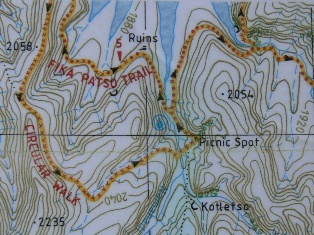
Continuing on your journey, you will continue with the rock art on your right while heading for the top of the ridge. At the top of the ridge you can decide whether you will be taking the high (and easier) road along the ridge of the mountain. If you would like to get water and be closer to the dam, you can select the lower route. This is more of a challenging path as you will have to go up and down while crossing three fingers of the mountain range.
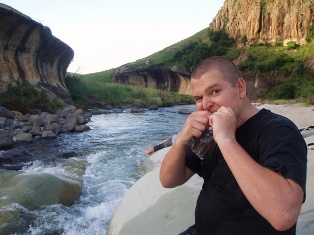 Be aware of snakes as we saw a cobra along the footpath which was clearly protecting its territory when we wanted to pass. Route markers are few and hard to find but they are there. This particular route was indicated by a yellow rectangle and were most commonly found on rocks. It is important to check about two to three meters from the ground to be able to see the faint remains of these drawings.
As your journey continues, you will pass the ruins on your left hand side. This is a good place to just re-cap that you are actually on the right path and heading in the right direction. You should now be at the entrance point of the longest (and middle) finger of the dam. This will set you in the right direction to your next stop. When you get to the water level, you will find that there is a tremendously peaceful spot where the stream will provide much needed water and recuperation.
Shade is limited so be sure to pick your spots well. If daylight is getting low, as it was for us, this is an excellent spot to set camp. This spot is called the picnic spot (See previous map and GPS: S28 41’54.5” E 28 51’40.9”). Note that the foliage may be quite dense. As you are close to water and swamp spots this would be where you would generously apply your mosquito repellent. Please also check your sleeping bag for sugar and hidden rocks placed by your colleagues who think they are very funny.
Day 2 – From the Picnic Spot along the Namahadi River to Suai Cave
 From the Picnic Spot you will be heading directly South to your next waypoint, Suai Cave (marked as Swaaigrotte on the map). The territory is mountainous and the foliage is heavy. You will travel in close proximity to the river but the foliage keeps you away from the river. About 30 mins to 1 hour after leaving the Picnic Spot, there is a cave on the right hand side. This is incidentally also the last point of cell phone reception, so bid your loved ones goodbye. From a safety point this would be your closest point to come back to for making an emergency call (GPS S28 42’11” E28 51’34.1). Upon our journey for the day, we only made it to the location of Suai Cave. Heading south from the Picnic spot and consulting your map, the second fork in the river is another good checkpoint for you (GPS: S28 42’45.4 E28 51’16.9). Stay left if you would like to head to the Namahadi pass, which is the location where you will find the Suai Cave.
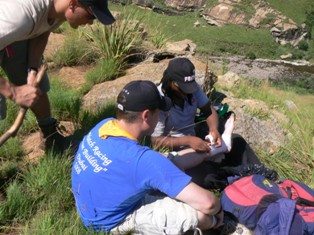 Weather was changing rapidly and we had an injured ankle which was affecting our speed. We made the decision to rather return back to Fika Patso and re-evaluate our journey. Had we continued we would have stayed to the left of the river (while heading south) and being as high up on the ridge as we could.
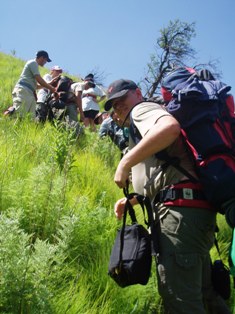
Coming back we took the high road, while choosing to take the steepest incline in order to get to the road more travelled. This was not necessarily the best choice as we lost valuable time having to rope up to protect us in case of anyone slipping. We would rather recommend that you take the longer and less steep route as it makes a much better, safer and easier journey. This will put you on the Circular Route which is not just scenic, but very easy to travel. For the safety of the group and the pleasure of your travel this would definitely be the better route to take. It is not just more scenic, but you will also find it easier as well as you will find some interesting scenes along the way.
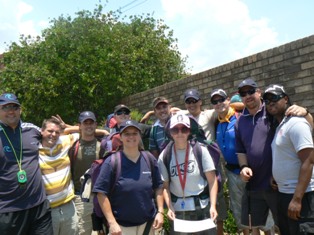
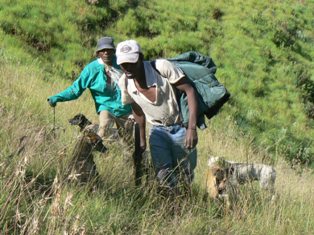 We came across this group of travellers/hunters who had appeared as from nowhere with their pack of hunting dogs. As we had taken too much food and had to get rid of some weight, we were happy to hand them some of our food and provisions.
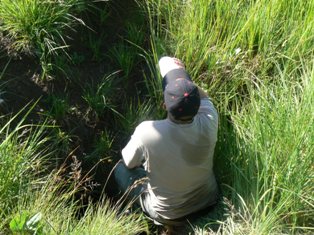
Continuing on that route there is an excellent point for getting more fresh water (GPS:S28 42’44.7” E28 51’08.0”). Note that it is directly on the foot path, hidden from view and quite a dangerous crossing if you have your eyes in the sky. Continuing further uphill will get you to a wonderful shady spot (GPS: S28 42’05.7 E28 50’50.7) to relax and revitalize your body.
When you continue on your way back to Fika Patso, reaching the top of the hill, you will find that there is beautiful scenery on both sides. You will discover interesting rock samples and small flowers that will be worth inspecting. Hold your breath because you are almost home. Our team was in great spirit, happy to be a team with some wonderful lessons learnt and returning with a full team. Never forget that with a single team member injured it affects the morale, speed and safety of the group.
Take care of your team and you will always make progress.
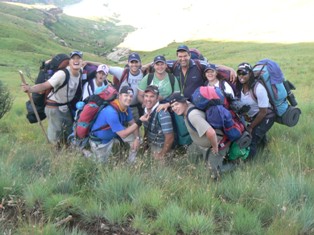
We spent the night at Witsieshoek where we had our executive team giving us some more exceptional lessons in communication within a team.
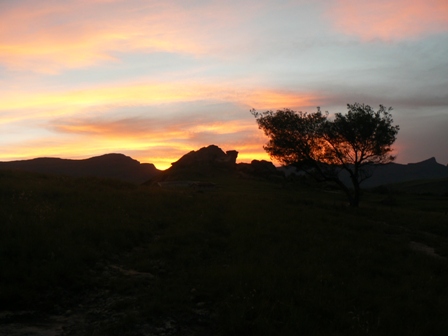
Day 3 – From Witsieshoek, to Sentinel Peak and back
From Witsieshoek you can travel by car along to the Sentinel Peak. The route is paved and well kept and is definitely worth the drive. Although you could drive with a normal car a vehicle with good ground clearance is essential. You will find that clouds can come in and go within a few minutes. You should pack and be prepared for any of these weather conditions. When you have paid your entrance fee of (R35 per person not staying the night, R185 per person if you are staying over at Witsieshoek) then you will start your journey with an easy and paved walk.
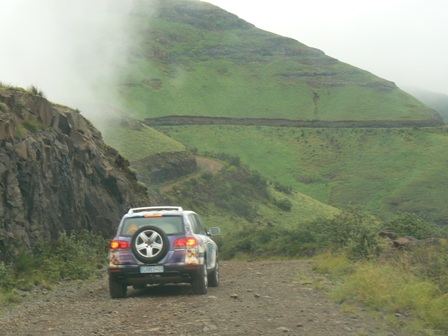
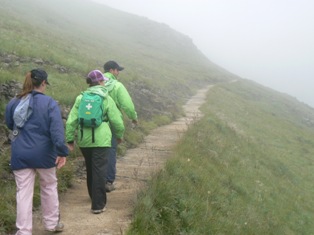
This Sentinel peak route was one of the clearer routes we have taken and is well worth it. Note that from a safety perspective you will have to consider some of the rocky places as well as some sections that definitely require your focus in order to remain safe.
Along the route you will have the opportunity to visit the view point or to continue to the summit. Weather permitting we would recommend that you continue on to the summit. There are plenty of places to see along the way and time is always of the essence.
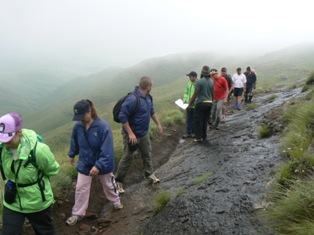
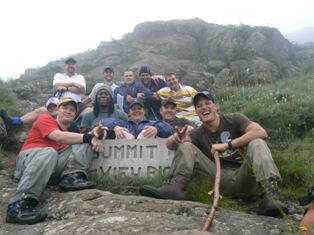
In the pictures below you can see how quick the visibility can change in the matter of a mere few seconds. The clouds shift from right in front of you to vanish right before your eyes.
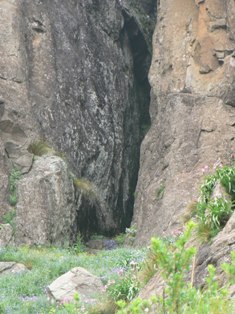
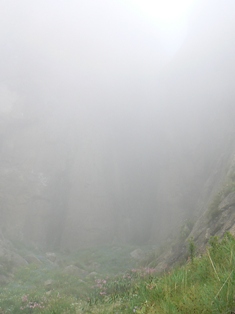
This is especially important if you would like to climb the chain ladder and it feels as if you are climbing straight into heaven. When you reach the ladders the first set the right one is the easier one, and when you reach the second set the left option is the easier one as they are closest to the rock face.
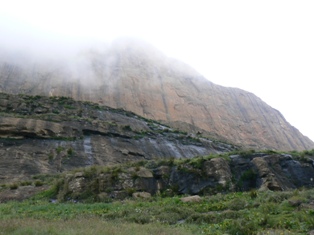
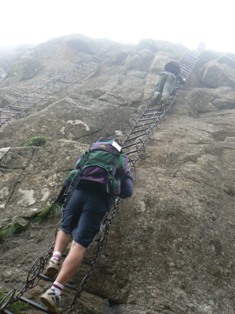

 Once you reach the top you will have the opportunity to bring your own rock. This may provide a challenge as most of the rocks on top have already been placed on the pile. Should one of your friends still have a rock in their sleeping bags this would be the prime opportunity to place it on the pile and release it from your back. Head into a south east direction and you will find that the terrain is flat and very easy to travel on a clear footpath. There is an abundance of water and you will pass a guard hut on your right hand side.
After 30 minutes from the chain ladder, weather permitting you will get the opportunity to experience one of the most breathtaking views from the second highest waterfall in the world. This is where the movie “The Gods must be Crazy” filmed “the edge of the world" section.
 See if you can spot the person at the top end of the waterfall (picture left). Enjoy the moment. Take it in. In our total journey, each person took 62,863 steps!
This provides the perfect time to mark your mountain!
Congratulations and have a safe journey back!

All photo credits: Elephants in Main Street International
Elephants in Main Street International is a dynamic consulting and teambuilding company.
We are the market leaders in the industry and have global clients across all sectors of the economic spectrum. We have operations in Southern Africa, the United Kingdom, Dubai and Australia.
Our programmes and processes are designed to help organisations, teams and individuals become more effective, more efficient and more able to produce high quality desirable results through more effective communication, a better understanding of people and through the creation of a set of agreements which enable them to win together.
We have a large number of programmes, products and services that are all highly customisable and that can be facilitated to ensure that specific objectives are achieved. In this way we can ensure that the specific needs of our clients are always met.
Our facilitators are extremely carefully chosen. The primary quality is ability, plus a great willingness to work with teams to effect better production and performance. They have to be leaders. They have to be able to face up to and coach the delegates through the various projects at precisely the right gradient to effect positive change.
Our facilitators have a deep and practical understanding, born of experience and training, of what makes people tick. Better understanding, better co-operation, better communication and better conflict handling are part and parcel of our courses and our facilitators have to be better at these than anyone else.
With the above in mind, Project Namahadi was specifically designed as part of our extensive and ongoing training programme to ensure that our facilitators are the best and most sought after in the industry to ensure that needs and objectives of our clients are always met.
The process was a huge success. Not only did the team as a whole grew stronger from the process and experience, but each individual who participated attested to very powerful learning’s that are relevant and applicable to their everyday lives and responsibilities.

