Of Horses and of Men
15 Apr 2013 05:09 #56702
by Selous
Of Horses and of Men was created by Selous
Hi All
A Story from a Few years back
Of Horses and of Men
Hiking the Eastern Cape
Dragging a stubborn horse, euphemistically dubbed Slowcoach, through a wetland in swirling mist on our second day into the remote Southern Drakensberg made me reflective and I lost concentration. Slowcoach sensed my wondering mind and stopped to snatch a mouthful of mist-coated grass, catching me off balance and landing me on my backside. It had been a battle of wills right from the start, and Slowcoach had assessed my weak points within a few hours of us becoming acquainted. He knew just how much he could get away with. I got up, wiped the wet mud from my waterproof pants, gave the beast a death stare and continued to drag him along with him munching his ill-gotten mouthful of grass with a smug look on his face. As per many other hikes, I started questioning what I was doing here far away from the comfort of wife and home.
Our trip into the seldom-visited Southern Drakensberg was more than a holiday hike, as we were part of the Maloti-Drakensberg Transfrontier Project team that was conducting a rapid biodiversity survey of the area. It was a large group of 13 individuals with varied ‘berg experience, comprising botanists (plants), ornithologists (birds), herpetologists (frogs and reptiles) and protected area planners. Team leader Richard Lechmere-Oertel invited myself and another experienced ‘berg hiker, Jeremy Cech, to bolster the experience of the group. Jeremy and I jumped at the opportunity to recce a section of the ‘berg that we would be traversing during the 700km Spine of the Dragon Traverse in April 2008.
We left PMB for Ongeluksnek border post before dawn, having met each other over a quick cup of steaming coffee outside Richard’s home. The 4.5 hour trip was filled with reminiscing and ruminating on past fun times, and much discussion on the relative merits of equipment brands, backpack weights and Richard’s ambitious route choice for the next three and a half days. Due to the number of people and all the survey equipment involved, Richard had organised six local horses and two horse handlers to carry the bulk of the baggage, with each person carrying only their personal possessions. It seemed like a fantastic idea.
On arrival at the border post, transferring the baggage from the vehicles to the horses caused much consternation with the local police officer. In vain he tried to create some kind of order while stepping over our ‘kit explosion’ in the forecourt at the police post. He told me later that he was used to only two or three people passing through here a week, and such a commotion as we made was not heard of. Packing a saddle bag is not a trivial exercise. Richard, who carries an inbreed distrust of horses, had lightly assumed we would stuff our baggage into a few canvas bags and lash them onto our sturdy beasts – ala Basotho donkey style. This was a significant error, which was to cost us much time during the hike. Fortunately we had Chris Wex, OiC from Cobham, with us and he had much experience with pack horses.
Chris took charge of the loading of the horses and he showed the guys of the group how it must be done, ensuring equal pack weights with a hand scale. Apparently, even a half kilo difference can cause a saddle to fall off in steep terrain. To load the horses and to make sure that all their weights were correct took about an hour and a half. Granted this was new to all of us, but I still could not get over how long it took! Over the next three days we came to realise how invaluable Chris’s experience with pack and trail horses was. Repeatedly during the trip, a new problem would arise and Chris would always have a solution. There were many times during the hike when we all gave thanks for Chris’ experience as we would not have even left the border post without him.
Richard needed to get the group going as it was past midday and we still were still waiting for the herpetofaunal team from Harrismith, so Jem and I agreed to stay behind and wait while the main party moved out with the horses. Rich, Jem and I studied the map carefully and arranged where we would all link up later that afternoon.
Eventually, the Herp team arrived and we set off to catch the main group. It was not an ideal time to start walking up a pass. The day was still, dry and warm. A typical autumn day. Sweat poured off us as the gradient increased, but by the time we reached the top it turned cold again as the sun dipped in its westward trajectory and a strong cold wind blew through the gap of the pass. However, fortified by a quick hot chocolate brew and a few more protective layers, we were soon off to catch the main group.
Richard had made slow progress with the horses because the handlers were trying to herd the pack horses, who turned out to be most reluctant to move anywhere beyond the closest grass patch. Regular escapes by these ill-trained beasts required a roundup over rough terrain that usually caused the pack to slip off, necessitating another stop to re-secure the packs. It was only after Chris made the handlers catch the horses and give each one to a person to lead by rein that progress became a little faster.
We caught up with the main group at dusk, having done only 7 km of our planned 12 km for the day. Although Richard had organised the baggage with military precision, another ‘kit explosion’ ensued as the tents and personal belongings were distributed, and Richard’s well organised food parcels, individually packed for breakfast, lunch and dinner dissipated into a communal food pile. Our camp site resembled an aeroplane crash site.
The hiking party split into cook groups and soon an informal competition was on to see who could get dinner cooked the fastest. There was much encouragement derived from the bottle of Old Brown Sherry that made several circuits. It never fails to amaze me that how a group of strangers can loose their social norms during a hike. Spoons, pots and mugs soon become communal as food is eagerly gulped down and a mug of steaming hot chocolate is passed around for all to share. Ahhh, the mountains are such a leveller. An impending storm drove the tired trekkers to an early bed but not before the horses were hobbled. That night at around 11 pm the rain came down gently and continued until just before dawn.
Dawn broke without it’s customary golden orb to the east, and we all woke with a thick bank of mist bellowing and licking it’s way into the Southern high berg. We quickly got everybody up so that breakfast could be cooked and the horses packed. Our expectations of a quick getaway were soon dampened by the two hour process of repacking the highly dispersed and now wet kit explosion into neat, equally weighted, saddle packs. Those people who didn’t dislike horses were each given one to lead. This was when I made my acquaintance with Slowcoach. From that second morning we would walk every step together. These Basotho ponies have a real sense of calm about them and they seemed bomb proof. However, they are also like trying to start a cold diesel engine.
Everybody had the feeling that it was going to be a cold a wet day of walking. Our second day should have had some incredible scenery (according to the map) but the thick mist hid it all as it worked its way into the lower valleys and then enveloped the high peaks too. The day became a long haul through the continual mist and fine drizzle, the type that will soak you through without the correct rain gear on. We hugged the escarpment using our trusty GPS’ to follow Richard’s pre-plotted route around the high crags and steep edges. Our self-appointed navigator, Brent Corcoran, did a fine job of following the route in some difficult conditions. He even managed to get us through some very big wetland areas with few wet feet. We covered a distance of about 18 km that day and the group were very wet and miserable by the time camp was pitched. Spirits rose at the prospect of a warm dinner and positively soured when another bottle of OB’s was passed around! Dinner was prepared as the drizzle got heavier and dusk enveloped us a lot faster than normal. As everybody went to bed there were whispered prayers that day three would dawn bright and clear.
Richard awoke early with not even a hint of dawn on the eastern horizon yet. The sky was inky black dotted with bright twinkling stars. He made it known that today was going to be bright and clear. Shouts from all the tents of “Coffee please, milk with two sugars!” made him realise he should have waited in silence a while longer. With Richard on coffee duty, everybody made their appearance from the tents and made cold dashes to the closest rock sanctuary to perform their morning ablutions. Breakfast was prepared as the horses were packed and we were off a little earlier than before. The packing of the horses was much easier as each handler knew what to do with their allotted horse. The sun’s rays had lifted our spirits despite a chilly wind blowing across the stunning highlands Southern berg. This was why I had come - to finally see this magnificent piece of the world.
Richard and the survey team needed to get some of the biodiversity data that was the point of the whole trip, so we split the group into two. The horses and handlers were to lead the way until lunch, where the survey team would catch up. Despite clear weather, the horses were still very slow, with any uphill further dropping the pace and we were often pulled to halt by the packhorses, their chests heaving. Chris said that the horses were very hungry and undernourished, and were not very fit at all, hence their inability to cope with the terrain. We got talking on the exciting subject of trail horses and what they were capable of with the correct training and nutrition, and my imagination ran wild for other adventures in the future using more sturdy animals.
The walk between breakfast and lunch was incredible for everybody. We were able to walk on the escarpment edge and see panoramic vistas of the largely unknown Southern Drakensberg. I felt privileged to be there in those majestic mountains and rural areas of the Eastern Cape dotted with farmlands and rural communities. To our west lay the interior of Lesotho with its vast valleys and mountains. We often heard the alarm call of the Mountain Rhebok and were amazed by their fleet-footedness over very precipitous terrain.
Richard, Jem, Brent and I were concerned about our falling behind schedule as we still had a considerable distance to cover if we were to get to our cars at Tenahead Lodge near Naude’s Nek, and we only had a day and half left. We decided that we had a number of options available to us and later that day we would make a decision if our progress was still slow. The two groups split up again after lunch so that the survey team could gather some more data. The horses were a little better after their rest and the little oats that we could spare. We decided on a camp spot for the two groups to meet up again. The afternoon session passed with two beautiful sightings off the Bearded Vulture gliding effortlessly with warm updrafts along the escarpment edge.
As we reached the appointed camp spot at Tsatsana Gate, approximately half way into the overall route, Richard and the rest of the team came into view. It was time to make the decision on how to proceed. Some afternoon mist started an ominous invasion of the high berg; probing like tentacles of a giant octopus, swirling then vanishing only to be replaced by one or two more arms probing deeper into the valleys. A group discussion ensued and it seemed best that Richard, Jeremy and I would push through into the night to reach Tenahead Lodge by lunch the following day. The rest of the group, lead by Chris and Brent, would head down Tsatsana Gate Pass with the horses the following morning. We would meet on the Ulundi-Fletcherville ring road the following afternoon at about 3pm.
Hot chocolate was brewed while the three of us gathered what was needed for the night away from the main group. The steaming brew spread warmth through our bodies, energising us for the 15 km that lay ahead that night. Without further delay, we headed off into the mist as the main group settled down for supper and a good kip. I think everybody was relieved that they would be descending the next day as they contemplated their sore legs and large blisters.
A night hike is always very different from a day hike. It is impossible to see the immediate topography and you blindly follow the GPS according to its route, picking up pre-programmed waypoints every 500m or so. Our walk that night was made even more difficult by the mist that got thicker and thicker. Even our headlamps became a hindrance as the reflected light interfered with our night vision; like being in a car with your brights on a misty night. We ended up holding the lights at knee level to shine under the mist, imitating fog lights. We were all happy to be away from the burden of the horses and we knew that we would only take five or so hours to cover the 15km to an area that we ear-marked to spend the night. It was situated in a massive wetland on the South African side of the high berg. We progressed well, stopping once to a share a delightful bar of Cadburys mint Chocolate in the most surreal of conditions.
We had one very scary incidence when confronting a 2-3 m high rock ledge across our route. Our next waypoint was 300 metres ahead, and we couldn’t see further than about 2m, so we didn’t know which was the best way down. We found a small gully which was too dangerous to go down with our packs on. Richard took off his pack and moved slowly down the gully over wet slippery rocks grasping onto tufts of grass. All our rucksacks were passed down to him where he placed them on a narrow ledge. Jeremy and I proceeded gingerly down to join Richard. We reached the base of the cliff and I was very concerned about where we were as the topography was still very steep. We decided to throw a rock ahead to see if we were as close to edge as what I believed, and it was several long seconds before we heard the crash of the rock hitting the valley floor a very long way below us. We did a quick about turn and detoured around what we later found to be a very narrow abyss that was too small to be on the map. It was a very close shave - one always to remember.
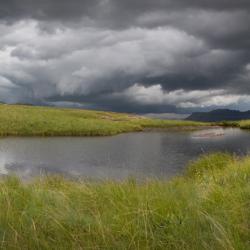
It was a fantastic feeling walking along the massive watershed knowing that camp was close by. The mist, cold and the long days made me long for my warm down sleeping bag. We pitched our tent and got some hot water on the boil for a hot cup of soup. While the water was boiling, we all went for an ice-cold wash at 11 o’clock at night with the air temperature hovering just above freezing. I cannot explain the feeling of dipping oneself into ice-cold pond scrubbing and washing vigorously and then jumping out and getting into warm clean cloths. It leaves one with a truly invigorating feeling that you are alive!
Tenahead Lodge was a hop, skip and a jump away now as we had broken the back of the distance after our night’s walk. We did the last 10 km in few hours after breaking camp the next morning. However, it always amazes me how the body starts to shut down towards the end of a hike. It does not matter if you are on a 10 or a 100 km hike, but two km from the end the legs start to feel tired. The Lodge was a magnificent site as we rounded the last valley, and we enjoyed a delicious cup of coffee there, feeling a bit out of place and very smelly in the very smart décor.
After fixing a puncture, we drove to find our hiking friends who we hoped had had a successful descent down from Tsatsana Gate. After three hours of driving through some of the most scenic and picturesque valleys we were finally reunited with the rest of the group. Slowcoach was there and I said my goodbyes to my stubborn friend with a generous helping of oats and slap on the neck. The group on the other hand some well deserved beers and group photo to remind us of our amazing time in the far reaches of the Southern Drakensberg.
For me, walking through the remote, uninhabited Southern Drakensberg was an incredible experience. This region had a different feel compared to the Central and Northern Drakensberg with an exciting harsh splendour about it and a remoteness that always keeps you on your toes. It is an area for which one must be properly prepared and planning is essential. Being so far south always means that there is greater chance of heavy snow falls from cold fronts in the winter months. There is little chance of bumping into fellow hikers and there are no KZN parks at regular intervals along the way. It is worth mentioning the local herders whom we encountered were always friendly and generous with their smiles. We had noted several really beautiful spots that are going to require a revisit, with one particularly stunning waterfall campsite that is well worth spending a night or two at.
A Story from a Few years back
Of Horses and of Men
Hiking the Eastern Cape
Dragging a stubborn horse, euphemistically dubbed Slowcoach, through a wetland in swirling mist on our second day into the remote Southern Drakensberg made me reflective and I lost concentration. Slowcoach sensed my wondering mind and stopped to snatch a mouthful of mist-coated grass, catching me off balance and landing me on my backside. It had been a battle of wills right from the start, and Slowcoach had assessed my weak points within a few hours of us becoming acquainted. He knew just how much he could get away with. I got up, wiped the wet mud from my waterproof pants, gave the beast a death stare and continued to drag him along with him munching his ill-gotten mouthful of grass with a smug look on his face. As per many other hikes, I started questioning what I was doing here far away from the comfort of wife and home.
Our trip into the seldom-visited Southern Drakensberg was more than a holiday hike, as we were part of the Maloti-Drakensberg Transfrontier Project team that was conducting a rapid biodiversity survey of the area. It was a large group of 13 individuals with varied ‘berg experience, comprising botanists (plants), ornithologists (birds), herpetologists (frogs and reptiles) and protected area planners. Team leader Richard Lechmere-Oertel invited myself and another experienced ‘berg hiker, Jeremy Cech, to bolster the experience of the group. Jeremy and I jumped at the opportunity to recce a section of the ‘berg that we would be traversing during the 700km Spine of the Dragon Traverse in April 2008.
We left PMB for Ongeluksnek border post before dawn, having met each other over a quick cup of steaming coffee outside Richard’s home. The 4.5 hour trip was filled with reminiscing and ruminating on past fun times, and much discussion on the relative merits of equipment brands, backpack weights and Richard’s ambitious route choice for the next three and a half days. Due to the number of people and all the survey equipment involved, Richard had organised six local horses and two horse handlers to carry the bulk of the baggage, with each person carrying only their personal possessions. It seemed like a fantastic idea.
On arrival at the border post, transferring the baggage from the vehicles to the horses caused much consternation with the local police officer. In vain he tried to create some kind of order while stepping over our ‘kit explosion’ in the forecourt at the police post. He told me later that he was used to only two or three people passing through here a week, and such a commotion as we made was not heard of. Packing a saddle bag is not a trivial exercise. Richard, who carries an inbreed distrust of horses, had lightly assumed we would stuff our baggage into a few canvas bags and lash them onto our sturdy beasts – ala Basotho donkey style. This was a significant error, which was to cost us much time during the hike. Fortunately we had Chris Wex, OiC from Cobham, with us and he had much experience with pack horses.
Chris took charge of the loading of the horses and he showed the guys of the group how it must be done, ensuring equal pack weights with a hand scale. Apparently, even a half kilo difference can cause a saddle to fall off in steep terrain. To load the horses and to make sure that all their weights were correct took about an hour and a half. Granted this was new to all of us, but I still could not get over how long it took! Over the next three days we came to realise how invaluable Chris’s experience with pack and trail horses was. Repeatedly during the trip, a new problem would arise and Chris would always have a solution. There were many times during the hike when we all gave thanks for Chris’ experience as we would not have even left the border post without him.
Richard needed to get the group going as it was past midday and we still were still waiting for the herpetofaunal team from Harrismith, so Jem and I agreed to stay behind and wait while the main party moved out with the horses. Rich, Jem and I studied the map carefully and arranged where we would all link up later that afternoon.
Eventually, the Herp team arrived and we set off to catch the main group. It was not an ideal time to start walking up a pass. The day was still, dry and warm. A typical autumn day. Sweat poured off us as the gradient increased, but by the time we reached the top it turned cold again as the sun dipped in its westward trajectory and a strong cold wind blew through the gap of the pass. However, fortified by a quick hot chocolate brew and a few more protective layers, we were soon off to catch the main group.
Richard had made slow progress with the horses because the handlers were trying to herd the pack horses, who turned out to be most reluctant to move anywhere beyond the closest grass patch. Regular escapes by these ill-trained beasts required a roundup over rough terrain that usually caused the pack to slip off, necessitating another stop to re-secure the packs. It was only after Chris made the handlers catch the horses and give each one to a person to lead by rein that progress became a little faster.
We caught up with the main group at dusk, having done only 7 km of our planned 12 km for the day. Although Richard had organised the baggage with military precision, another ‘kit explosion’ ensued as the tents and personal belongings were distributed, and Richard’s well organised food parcels, individually packed for breakfast, lunch and dinner dissipated into a communal food pile. Our camp site resembled an aeroplane crash site.
The hiking party split into cook groups and soon an informal competition was on to see who could get dinner cooked the fastest. There was much encouragement derived from the bottle of Old Brown Sherry that made several circuits. It never fails to amaze me that how a group of strangers can loose their social norms during a hike. Spoons, pots and mugs soon become communal as food is eagerly gulped down and a mug of steaming hot chocolate is passed around for all to share. Ahhh, the mountains are such a leveller. An impending storm drove the tired trekkers to an early bed but not before the horses were hobbled. That night at around 11 pm the rain came down gently and continued until just before dawn.
Dawn broke without it’s customary golden orb to the east, and we all woke with a thick bank of mist bellowing and licking it’s way into the Southern high berg. We quickly got everybody up so that breakfast could be cooked and the horses packed. Our expectations of a quick getaway were soon dampened by the two hour process of repacking the highly dispersed and now wet kit explosion into neat, equally weighted, saddle packs. Those people who didn’t dislike horses were each given one to lead. This was when I made my acquaintance with Slowcoach. From that second morning we would walk every step together. These Basotho ponies have a real sense of calm about them and they seemed bomb proof. However, they are also like trying to start a cold diesel engine.
Everybody had the feeling that it was going to be a cold a wet day of walking. Our second day should have had some incredible scenery (according to the map) but the thick mist hid it all as it worked its way into the lower valleys and then enveloped the high peaks too. The day became a long haul through the continual mist and fine drizzle, the type that will soak you through without the correct rain gear on. We hugged the escarpment using our trusty GPS’ to follow Richard’s pre-plotted route around the high crags and steep edges. Our self-appointed navigator, Brent Corcoran, did a fine job of following the route in some difficult conditions. He even managed to get us through some very big wetland areas with few wet feet. We covered a distance of about 18 km that day and the group were very wet and miserable by the time camp was pitched. Spirits rose at the prospect of a warm dinner and positively soured when another bottle of OB’s was passed around! Dinner was prepared as the drizzle got heavier and dusk enveloped us a lot faster than normal. As everybody went to bed there were whispered prayers that day three would dawn bright and clear.
Richard awoke early with not even a hint of dawn on the eastern horizon yet. The sky was inky black dotted with bright twinkling stars. He made it known that today was going to be bright and clear. Shouts from all the tents of “Coffee please, milk with two sugars!” made him realise he should have waited in silence a while longer. With Richard on coffee duty, everybody made their appearance from the tents and made cold dashes to the closest rock sanctuary to perform their morning ablutions. Breakfast was prepared as the horses were packed and we were off a little earlier than before. The packing of the horses was much easier as each handler knew what to do with their allotted horse. The sun’s rays had lifted our spirits despite a chilly wind blowing across the stunning highlands Southern berg. This was why I had come - to finally see this magnificent piece of the world.
Richard and the survey team needed to get some of the biodiversity data that was the point of the whole trip, so we split the group into two. The horses and handlers were to lead the way until lunch, where the survey team would catch up. Despite clear weather, the horses were still very slow, with any uphill further dropping the pace and we were often pulled to halt by the packhorses, their chests heaving. Chris said that the horses were very hungry and undernourished, and were not very fit at all, hence their inability to cope with the terrain. We got talking on the exciting subject of trail horses and what they were capable of with the correct training and nutrition, and my imagination ran wild for other adventures in the future using more sturdy animals.
The walk between breakfast and lunch was incredible for everybody. We were able to walk on the escarpment edge and see panoramic vistas of the largely unknown Southern Drakensberg. I felt privileged to be there in those majestic mountains and rural areas of the Eastern Cape dotted with farmlands and rural communities. To our west lay the interior of Lesotho with its vast valleys and mountains. We often heard the alarm call of the Mountain Rhebok and were amazed by their fleet-footedness over very precipitous terrain.
Richard, Jem, Brent and I were concerned about our falling behind schedule as we still had a considerable distance to cover if we were to get to our cars at Tenahead Lodge near Naude’s Nek, and we only had a day and half left. We decided that we had a number of options available to us and later that day we would make a decision if our progress was still slow. The two groups split up again after lunch so that the survey team could gather some more data. The horses were a little better after their rest and the little oats that we could spare. We decided on a camp spot for the two groups to meet up again. The afternoon session passed with two beautiful sightings off the Bearded Vulture gliding effortlessly with warm updrafts along the escarpment edge.
As we reached the appointed camp spot at Tsatsana Gate, approximately half way into the overall route, Richard and the rest of the team came into view. It was time to make the decision on how to proceed. Some afternoon mist started an ominous invasion of the high berg; probing like tentacles of a giant octopus, swirling then vanishing only to be replaced by one or two more arms probing deeper into the valleys. A group discussion ensued and it seemed best that Richard, Jeremy and I would push through into the night to reach Tenahead Lodge by lunch the following day. The rest of the group, lead by Chris and Brent, would head down Tsatsana Gate Pass with the horses the following morning. We would meet on the Ulundi-Fletcherville ring road the following afternoon at about 3pm.
Hot chocolate was brewed while the three of us gathered what was needed for the night away from the main group. The steaming brew spread warmth through our bodies, energising us for the 15 km that lay ahead that night. Without further delay, we headed off into the mist as the main group settled down for supper and a good kip. I think everybody was relieved that they would be descending the next day as they contemplated their sore legs and large blisters.
A night hike is always very different from a day hike. It is impossible to see the immediate topography and you blindly follow the GPS according to its route, picking up pre-programmed waypoints every 500m or so. Our walk that night was made even more difficult by the mist that got thicker and thicker. Even our headlamps became a hindrance as the reflected light interfered with our night vision; like being in a car with your brights on a misty night. We ended up holding the lights at knee level to shine under the mist, imitating fog lights. We were all happy to be away from the burden of the horses and we knew that we would only take five or so hours to cover the 15km to an area that we ear-marked to spend the night. It was situated in a massive wetland on the South African side of the high berg. We progressed well, stopping once to a share a delightful bar of Cadburys mint Chocolate in the most surreal of conditions.
We had one very scary incidence when confronting a 2-3 m high rock ledge across our route. Our next waypoint was 300 metres ahead, and we couldn’t see further than about 2m, so we didn’t know which was the best way down. We found a small gully which was too dangerous to go down with our packs on. Richard took off his pack and moved slowly down the gully over wet slippery rocks grasping onto tufts of grass. All our rucksacks were passed down to him where he placed them on a narrow ledge. Jeremy and I proceeded gingerly down to join Richard. We reached the base of the cliff and I was very concerned about where we were as the topography was still very steep. We decided to throw a rock ahead to see if we were as close to edge as what I believed, and it was several long seconds before we heard the crash of the rock hitting the valley floor a very long way below us. We did a quick about turn and detoured around what we later found to be a very narrow abyss that was too small to be on the map. It was a very close shave - one always to remember.
It was a fantastic feeling walking along the massive watershed knowing that camp was close by. The mist, cold and the long days made me long for my warm down sleeping bag. We pitched our tent and got some hot water on the boil for a hot cup of soup. While the water was boiling, we all went for an ice-cold wash at 11 o’clock at night with the air temperature hovering just above freezing. I cannot explain the feeling of dipping oneself into ice-cold pond scrubbing and washing vigorously and then jumping out and getting into warm clean cloths. It leaves one with a truly invigorating feeling that you are alive!
Tenahead Lodge was a hop, skip and a jump away now as we had broken the back of the distance after our night’s walk. We did the last 10 km in few hours after breaking camp the next morning. However, it always amazes me how the body starts to shut down towards the end of a hike. It does not matter if you are on a 10 or a 100 km hike, but two km from the end the legs start to feel tired. The Lodge was a magnificent site as we rounded the last valley, and we enjoyed a delicious cup of coffee there, feeling a bit out of place and very smelly in the very smart décor.
After fixing a puncture, we drove to find our hiking friends who we hoped had had a successful descent down from Tsatsana Gate. After three hours of driving through some of the most scenic and picturesque valleys we were finally reunited with the rest of the group. Slowcoach was there and I said my goodbyes to my stubborn friend with a generous helping of oats and slap on the neck. The group on the other hand some well deserved beers and group photo to remind us of our amazing time in the far reaches of the Southern Drakensberg.
For me, walking through the remote, uninhabited Southern Drakensberg was an incredible experience. This region had a different feel compared to the Central and Northern Drakensberg with an exciting harsh splendour about it and a remoteness that always keeps you on your toes. It is an area for which one must be properly prepared and planning is essential. Being so far south always means that there is greater chance of heavy snow falls from cold fronts in the winter months. There is little chance of bumping into fellow hikers and there are no KZN parks at regular intervals along the way. It is worth mentioning the local herders whom we encountered were always friendly and generous with their smiles. We had noted several really beautiful spots that are going to require a revisit, with one particularly stunning waterfall campsite that is well worth spending a night or two at.
Please login or register to view the images attached to this post.
Please Log in or Create an account to join the conversation.


15 Apr 2013 07:18 #56704
by HFc
Replied by HFc on topic Of Horses and of Men
Great write up which I enjoyed reading immensely!
The following user(s) said Thank You: Selous
Please Log in or Create an account to join the conversation.