
First Ascent of pinnacle on Ncedamabutho Ridge
 Will shut up now.
Well done. Braver men than me!
Please Log in or Create an account to join the conversation.
- Serious tribe
-

- Offline
- Platinum Member
-

- Posts: 1064
- Thank you received: 784

Please Log in or Create an account to join the conversation.

Please Log in or Create an account to join the conversation.

The ridge line linking Mponjwane to the two Mnweni Needles contains a number of subsidiary peaks. The highest one, just below Mponjwane was our objective.
Approach
The easiest way to approach this peak is to walk up the Ntonjelane River and then moving up the valley leading up to the two Mnweni Needles. After leaving the Ntonjelane valley, this would be easiest done by first walking up the arête to the true right and then contouring in to the valley as the ridge gets steeper. Take the left hand split leading up towards the subsidiary peaks. Then either bivi at the last water, or carry water and bivi on the neck between the second hump left of the Inner Mnweni Needle and the subsidiary peaks right of the objective.
From the neck scramble up the side of the subsidiary peaks going first up about 30m, then right along a grass band, then up and then left a fair distance until the way up becomes clear. Cross over the grassy shoulder and traverse across to get to the western side of the peak. After some distance you will encounter a steep sided gulley blocking your way. Scramble down about 60m passing a hole through the ridge, and the start of the first pitch is about 10m below the hole at a point where one can see a way to traverse into the gulley.
1. 25m E. Climb down a few meters and traverse right (looking up) crossing a short slab into the gully.
Scramble up the gully until there is a short steep section blocking the way. A prominent roof system lies just above and to the right.
2. 15m F1 . Climb the short section by smearing rightwards up a slab in the gully.
Walk 60m right on a grass ledge to gain a second gully. Go a few meters up this and a further 30m right to the western arête of the peak.
3. 30m F2. Climb up a shallow groove past a cave and into an obvious crack above. This pitch ends on top of a 3m high block forming a platform on the ridge. (this pitch has some loose rock)
4. 40m F2 . Climb down the block to the neck and make some balancy moves up and left around the corner. Continue up to a good stance.
40m Walk left on a grass ledge and stop below an obvious black layback crack.
5. 45m F2/F3 (16). Climb/straddle up the chimney / crack with a grassy exit, then continue up and leftwards on easier rock to the summit.
Descent
From the summit scramble down the north side to a large block. Abseil off this. A 50m abseil gets you to the neck forming the top of the second gully system, passing a large ledge about 20m down. From here scramble rightwards down the north east side to the neck between the peak and first subsidiary peak (the first gully system). Cross the neck and continue to scramble down to do a final 25m abseil off another large block to arrive at a point on the grass traverse before the first pitch. Reverse the rest of the scramble to the neck, the last section into the neck was also abseiled.
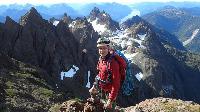
First Ascent: 27 April 2015 Andrew Porter, Neil Margetts, Chris Sommer
Take nothing but litter, leave nothing but a cleaner Drakensberg.
Please login or register to view the image attached to this post.
Please Log in or Create an account to join the conversation.

View of Ncedamabutho ridge on our walk in along the Itshana Elibovana valley. The peak is indicated by the arrow on the left, and the neck we were aiming for on the right:
Our bivy spot in sloped, bushy terrain at the last water in the gully before the neck:
Start of the approach scramble from the neck:
Typical terrain of the slopes above the neck:
The traverse after the initial steep scrambling:
Take nothing but litter, leave nothing but a cleaner Drakensberg.
Please login or register to view the images attached to this post.
Please Log in or Create an account to join the conversation.
Pitch 1
And up and up we go (first gully):
Pitch 2:
And we keep going up (second gully):
Then the exposed traverse across to the West Arete to the base of pitch 3:
It is entirely possible that there is a better approach to the West Arete, but I think we did well for pretty much an on-sight first ascent - some basic photo study and simple annotations were done as planning.
Take nothing but litter, leave nothing but a cleaner Drakensberg.
Please login or register to view the images attached to this post.
Please Log in or Create an account to join the conversation.
Neil starting up Pitch 3 on the West Arete - Grade F2
This pitch was characterised by loose rock. Several showers of rocks were loosed onto Andrew and I below.
The challenges of route finding in the Berg - especially on a new route: a piton was used as the first placement, after which Neil changed course because the initial line turned out to be too difficult. Rope drag picked up as a result and soon after I took this shot, I scrambled up to the first placement to remove the piton in order to alleviate the drag.
The loose rock on this pitch is mostly perched on an awkward, slabby traverse offering little foot and hand holds other than the treacherously loose rocks. After this traverse is a shallow recess shown in the shot below after which the pitch is soon over.
Take nothing but litter, leave nothing but a cleaner Drakensberg.
Please login or register to view the images attached to this post.
Please Log in or Create an account to join the conversation.
I'm interested in the quality of the rock on the pinnacle. Mponjwane stands out on the list of Berg routes I've done for the reasonable quality of the rock on the climb. The chemistry seems slightly different and probably accounts for the existence of Mponjwane itself - it is harder to erode than the rest of the escarpment nearby and therefore it has survived longer. I would have expected the rock quality to be similar on this pinnacle. So was that the case? Was the loose rock you point to simply a case of lumps lying about owing to lack of any previous traffic or was the rock also crumbly and Berg-dodgy?
Please Log in or Create an account to join the conversation.
@mnt_tiska
Overall the rock was pretty good. Neil lead a pitch through some loose stuff, but considering it was a first ascent it was not that bad. The rest of the rock was fairly solid. Being a first ascent, we of course took a lot of grassy stuff in favour of the easy line. There seems enough solid rock about for a "classic" and more direct line if someone feels like the effort
Please Log in or Create an account to join the conversation.
Neil and I climbed Mponj 2 days after this ascent and we definitely noticed that the rock there was relatively good - with the amount of traffic going up the route a lot of the loose stuff must have been cleaned off.
Take nothing but litter, leave nothing but a cleaner Drakensberg.
Please Log in or Create an account to join the conversation.
